
If you have ever wondered how Indian festivals are scheduled, or how astrologers find the perfect date for a wedding, the answer lies in a single, ancient astronomical tool: the Panchang.
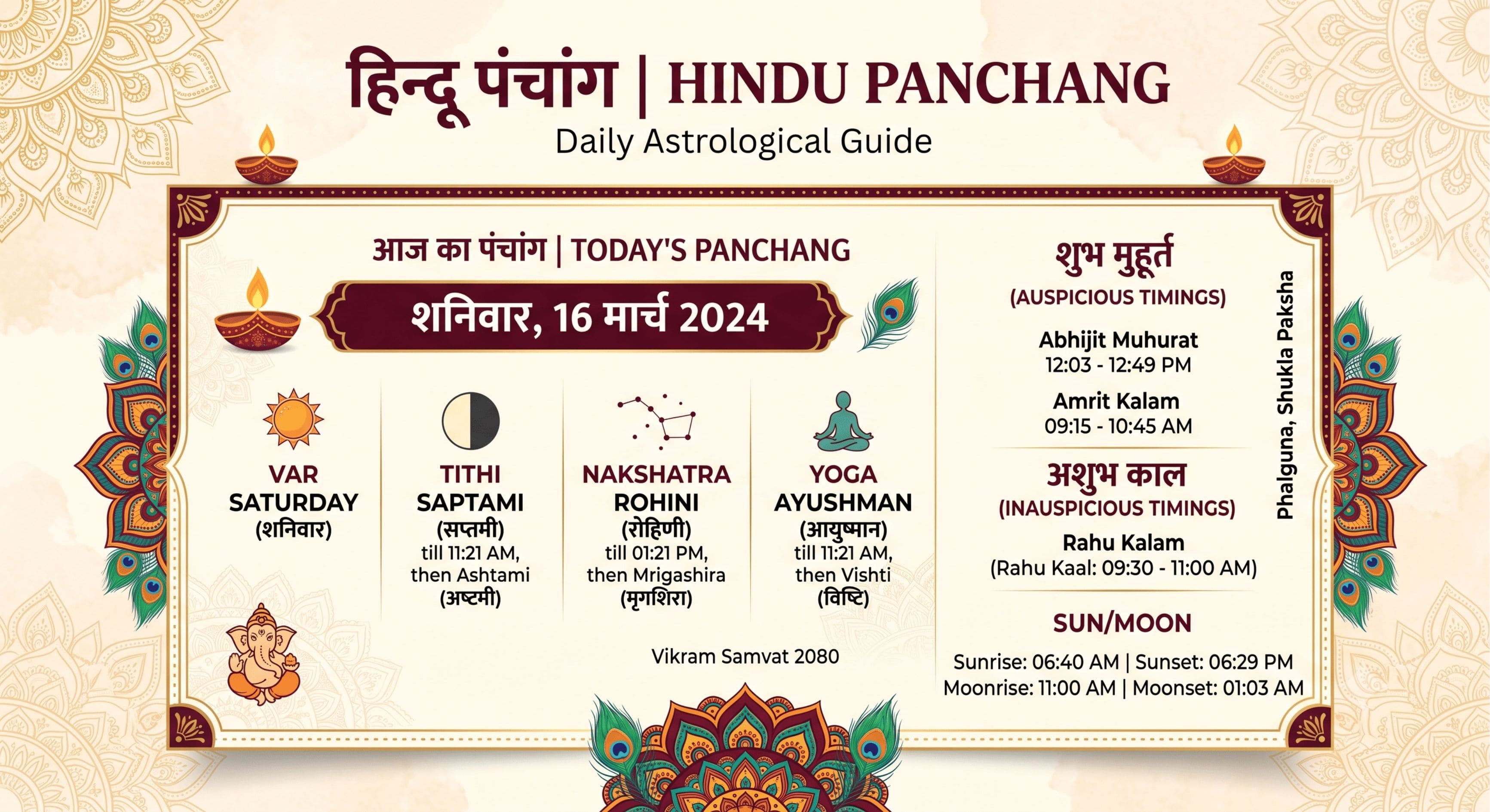
Often referred to as the Hindu almanac or Vedic calendar, the Panchang is far more complex than the standard Gregorian calendar we use daily. While a standard calendar tracks the Earth's movement around the Sun (a solar calendar), the Panchang is a luni-solar calendar. It meticulously tracks the complex, ever-shifting relationship between the Sun and the Moon.
The word Panchang is derived from two Sanskrit words: Pancha meaning "five," and Anga meaning "limbs" or "parts." Therefore, the Panchang is composed of five distinct astronomical elements. Let's break down each limb and understand its significance.
The 5 Limbs of the Panchang Explained
To read a Panchang, you must understand its five core pillars. Every single day has a unique combination of these five elements, which determines whether the day is auspicious (Shubh) or inauspicious (Ashubh) for specific activities.
1. Tithi (The Lunar Day)
A Tithi is the lunar day, calculated by the mathematical angle between the Sun and the Moon.
Unlike a 24-hour solar day, a Tithi can vary in length from 19 to 26 hours. There are 30 Tithis in a complete lunar month, divided into two phases of 15 days each:
- Shukla Paksha (Waxing Phase): The bright fortnight leading up to the Full Moon (Purnima). Generally considered highly auspicious for new beginnings and growth.
- Krishna Paksha (Waning Phase): The dark fortnight leading up to the New Moon (Amavasya). Better suited for introspection, clearing debts, or spiritual practices.
Types of Tithis include: Pratipada (1st), Dwitiya (2nd), Tritiya (3rd), all the way to Chaturdashi (14th), capped by either Purnima or Amavasya.
2. Vaar (The Day of the Week)
Vaar (or Vasara) is the easiest limb to understand, as it aligns perfectly with the standard seven-day week. Each day is governed by a specific planet, which influences the energy of that day.
- Ravivaar (Sunday): Ruled by the Sun. Good for leadership and administrative work.
- Somavaar (Monday): Ruled by the Moon. Good for emotional, nurturing, and public activities.
- Mangalvaar (Tuesday): Ruled by Mars. Best for aggressive, physical, or technical tasks.
- Budhvaar (Wednesday): Ruled by Mercury. Excellent for communication, business, and study.
- Guruvaar (Thursday): Ruled by Jupiter. Auspicious for wisdom, wealth, and spiritual ceremonies.
- Shukravaar (Friday): Ruled by Venus. Ideal for romance, arts, and purchasing luxuries.
- Shanivaar (Saturday): Ruled by Saturn. Best for hard labor, agriculture, and discipline.
3. Nakshatra (The Lunar Mansion)
As the Moon orbits the Earth, it travels through 360 degrees of the zodiac. Vedic astrology divides this path into 27 equal segments, each spanning 13°20'. These segments are the Nakshatras (birth stars or lunar mansions).
The Nakshatra active at any given moment is determined by exactly where the Moon is currently positioned in the sky.
- Total Types: There are 27 Nakshatras, beginning with Ashwini and ending with Revati.
- Significance: Nakshatras dictate the mental and emotional undercurrents of the day. For example, Pushya Nakshatra is considered incredibly auspicious for buying gold, while Bharani is considered too fierce for marriages.
4. Yoga (The Luni-Solar Angle)
Yoga mathematically calculates the combined longitudinal position of the Sun and the Moon. It essentially measures the relationship and distance between the two luminaries.
-
Total Types: Like Nakshatras, there are 27 Yogas.
-
Significance: Yogas indicate the overall "luck" or fundamental nature of the day.
- Auspicious Yogas (e.g., Ayushman, Saubhagya) bring prosperity and smooth progress.
- Inauspicious Yogas (e.g., Vyatipata, Vaidhriti) warn of obstacles, sudden changes, or health issues.
5. Karana (The Half-Tithi)
If a Tithi is a full lunar day, a Karana is precisely half of a Tithi. Because there are 30 Tithis in a month, there are 60 Karanas in a lunar month.
- Total Types: There are 11 distinct Karanas. Four are "Fixed" (Sthira) and occur only once a month near the New Moon. Seven are "Movable" (Chara) and repeat cyclically throughout the month.
- Significance: Karanas provide fine-tuned timing for daily activities. For example, the Bava Karana is excellent for starting journeys, while the Vishti Karana (also known as Bhadra) is notoriously malefic and avoided for any auspicious work.
Note: Because the Sun and Moon are constantly moving at different speeds, the five limbs are always shifting. A Tithi might change at 2:00 PM, while the Nakshatra changes at 8:00 PM.
The Panchang is highly location-dependent. Because it relies on the precise angle of the Sun and Moon relative to the Earth, the exact time a Tithi or Nakshatra ends in New York will be different from when it ends in New Delhi.